
By Bobby Wagner
On the first day of my internship at The Ringer, I Googled “podcast newsletters.” In retrospect, this is one of the most quaint things I’ve ever done, for a few reasons.
First, the notion of needing a newsletter to learn more about podcasts — a now inescapable medium that’s often the punchline of a mediocre joke — so that I could do my job better is very funny. Second, this was before newsletters had been subsumed into the very same media trends that have swallowed podcasts. Everyone’s got a newsletter, everyone’s got a podcast, no one has a media job. Third, this was back when Google actually worked.
This was 2018, a budding time for what would come to be known (rather ironically, in my view) as the podcast industry. Marc Maron and Joe Rogan had started their podcasts just under a decade earlier. Bill Simmons’ podcast, the show that launched the company I was now employed by, was 11 years old. Call Her Daddy’s first episode wouldn’t be posted for another three months. To get our baseball podcast, Tipping Pitches, on iTunes (<3), we still had to upload our audio files to a frankly deranged combination of Dropbox and WordPress before manually pinging a Feedburner.
Some things that I admit in this post will be a little embarrassing, but none more than this: I thought working in podcasting was the coolest thing I could possibly do. I thought it was cool we figured out how to have our own podcast. I thought it was downright amazing that I was cashing $13.25 an hour to help make the podcasts I had just spent the last three years inhaling. And, above all, I thought it was a borderline miracle that we occupied a corner of the internet that was interesting enough for there to be whole newsletters dedicated to it.

In early 2019, the newsletters started writing a lot about a music streaming company I had briefly subscribed to in college when I could still get the student price. That’s because, on February 6 of that year, Spotify announced it had acquired Gimlet for a jaw-dropping $230 million. This set the newsletters ablaze. Spotify went from a company that garnered the occasional passing mention in a newsletter — mostly when it would make minor UX improvements to the podcast listening experience on the platform (still waiting on that major UX improvement to the podcast listening experience) — to the single most important company in the podcasting world overnight. The Gimlet sale is a complicated tale, but it made one thing immediately obvious to media executives, Wall Street types, newsletter writers, LinkedIn posters, and anyone else of the sort: podcasting was big business now.
I’ll never forget where I was when that story broke. I was sitting in Pod Studio 1, the name of the more desirable of our two podcast studios at The Ringer’s original offices on an old Hollywood lot. It sounded better, it had a half wall between where the “talent” sat and where the producer sat (so I could avoid awkward eye contact with guests), and it had central air. We couldn’t put central air into the other podcast studio (you guessed it: “PS2”) because if you made any structural changes to the walls, it would disrupt the asbestos that was installed when the lot was built in 1912 or, worse, it would start raining termites from the ceiling. I’m actually not sure which is worse between those two things, now that I type this out. A coworker and I were waiting for a guest to show up for an appearance on a podcast I produced. We talked about Gimlet for five minutes, at most. We were, like the newsletter writers, a little stunned by the price. The irony here is not lost on me.

Around this time, I started to feel a growing dissonance between podcasting and the “podcast industry” that made it kind of darkly funny to wake up and do my job every day. It became a lot funnier a year later.
In March 2019, Spotify acquired Parcast, a scripted podcast and audio drama production company, for $56 million. Then, almost exactly a year after the Gimlet sale, Spotify acquired The Ringer for what most outlets now say was $250 million. It was first reported at $150 million, then $200 million, now $250 million.
Soon, it seemed like every media company was also a podcasting company. Have a newspaper? Launch your version of The Daily. Have a magazine? Let’s get that eight-part investigative audio documentary in production. Have a sports website? You’re long overdue for a “flagship podcast” about each of the major sports. And guess what? It was kind of awesome for a while! Hundreds, if not thousands, of good podcasts launched in this time. Tens of thousands of people wanting to get into media found production jobs at companies with a renewed sense of possibility. Resumes were built. Pro Tools was learned. This was the first (and in my view, the only) time that the idea of a podcast industry matched up with the existence of a podcast industry. I used to get regular LinkedIn messages from RECRUITERS, looking to offer me a more competitive salary…to make PODCASTS. But good times rarely last in media, particularly in the tech-accelerationist era that we’re living through right now.
Here’s how I saw what happened next:
Many companies rushed to launch podcast networks without much of a plan beyond feeling like they were behind the curve, but it’s hard to say there was malice in these decisions. Podcasting is, at its core, a low-overhead, high-upside medium. There were lessons to be learned about how hard it is to grow a podcast, how long it actually takes, and how rare it is to catch that lightning in a bottle, but most of us in “the industry” were content that media companies were willing to learn those lessons, seemingly in good faith.
The Pivot to Audio was different from 2015’s Pivot to Video (1.0) — the Facebook-driven video boom that launched a thousand media jobs, nearly all of which ended in layoffs — for mostly nerdy internet technology reasons. Because podcasts adopted Really Simple Syndication (more commonly known as RSS) as their distribution model in the early 2000s, podcasting audiences developed into some of the most “sticky” consumers on the entire internet. RSS insulated podcasting from the blatant lies about viewing metrics, impressions, and algorithms that prompted the Pivot to Video by doing one thing: making the medium an open standard, independent of any one site (like Facebook) that could turn off the faucet. The “industry” — the jobs opening, the shows being greenlit, the acceptance of podcasting as a legitimate medium — may have grown too rapidly and haphazardly for its own good, but the downstream effects of that paled in comparison to two things much more insidious that happened shortly after: the rise of the celebrity podcast and the Pivot to Video 2.0 (AKA 2 Pivot 2 Video).

I started to feel something shifting in May 2020 when I saw an internal announcement that Spotify had signed an exclusive licensing deal for The Joe Rogan Experience (for more money than most excellent starting pitchers get on the free agent market these days). To be clear, at the time, this feeling didn’t stem from the now-ubiquitous critiques of Rogan’s podcast — its lack of intellectual rigor, its spineless platforming of bad actors, its broad rejection of craft and tact (though I hated those things too) — it stemmed from the fact that Joe Rogan was a guy I knew from TV. He was a guy I knew from TV who had a podcast that was so successful he warranted, I guess, as much money as entire companies producing slates of shows I thought were incredible.
I knew copycat deals would come. But I also worked in podcasting, so I knew how rare The Joe Rogan Experience was — the biggest podcast in the world by an order of magnitude, such an outlier that there are almost no lessons to be learned from it as someone trying to make a successful podcast. But that didn’t stop others from trying. You’re one of the biggest rock artists of all time? Here, have a podcast with the former president. You’re the former president? Here, have a multi-show deal. You’re the royals? Here’s $20 million to do nothing. You’re Kim Kardashian? I actually don’t even know what came of this deal and I’m too tired while writing this to look it up. Tens, if not hundreds, of millions of dollars went to this strategy — all ignoring that Rogan got that money because of the audience his podcast had already built, not in anticipation of a future one.
I’m not naive about the business case for this. Podcasting is a hot medium that famous people seem to like playing around in…why not give them their own shows? Financially, they’ll be loss leaders, generating so much “earned media,” goodwill, and cool factor that it will define Spotify as a place where simply so many good podcasts exist that you have to be there. It seems to have worked for the Spotify app and the company’s shareholders. This was, however, ill-conceived for many of the shows it actually birthed. And this, in my view, is where the podcast industry was warped.
By morphing the industry to be another outlet for people who were already famous (and rich, that’s a big part of this too), Spotify and other tech companies left behind the original podcasting model. In a world where you’re slinging eight-figure deals for something that is cheap to make and historically free to access, your margins are slim. Your show better be bankable. There’s no time to let it grow organically with a no-name host — it must have mass appeal.
In essence, they recreated TV in the aggregate.
In a medium as expansive as podcasting, obviously this wasn’t true in all cases, and there remain countless exceptions. The Ringer, with Spotify’s approval, greenlit plenty of great shows while this change was happening, many of them hosted by colleagues I love and who would not be offended by me saying they are not famous. I worked on some and consider it, with hindsight, kind of amazing. While “the industry” was moving desperately toward being TV-lite, some podcast subgenres still managed to flourish. In our tiny internet lefty bubble alone, 5-4, Blowback, and This Machine Kills launched in 2020, TrueAnon and Know Your Enemy in 2019, and countless others. Pablo Torre Finds Out adapted and advanced investigative journalism for the podcast form. Who? Weekly created a refreshing and smart pop culture chat show. There are too many to name.

For the sake of argument, I will presume that the Pivot to Video 2.0 started for honest reasons. This definitely isn’t true, but I’m not presently interested in litigating the inner lives of tech executives. You know the story. YouTube eats linear TV, TikTok eats…everything, and suddenly there are only two ways to reach people: short-form video and long-form video. By 2025, there were a handful of apocalyptic statistics going around about Gen Z and podcast listening. Some sources had nearly two-thirds of podcast listeners under the age of 30 consuming podcasts on YouTube. Others found that only 10% of Gen Z listeners consume only audio podcasts. Wave hello to the meteor, podcast industry. It’s heading right toward you.
I dreaded this change for the same reasons that so many of my podcast production colleagues did, which is that making a video podcast kind of sucks in a lot of ways. It’s cumbersome. It’s awkward. It’s expensive. When The Ringer started moving its flagship shows to video, there were only two video-equipped studios at the Spotify LA campus. Trying to book a slot was like the Hunger Games. Above all else, I kept asking myself the same question: is what we’re adding to the show (discoverability on YouTube) worth what we’re losing (audio quality, editing flexibility, recording space, host comfort)?
The answer depends on who you ask. For media companies the size of The Ringer, owned by tech companies the size of Spotify, the answer seems to have been yes. Whether it’s on YouTube, Spotify, Netflix, SamsungTV, Hulu, Amazon, or any number of other places that video podcasts now occupy space in our digital dystopia, the fact that these shows are on video has unlocked something. I remember being surprised and kind of annoyed when I would see comments saying how much listeners appreciated that The Big Picture was now on video. It wasn’t just that people now had a totally different relationship to me and what I look like. I had to update my priors, and I hate updating my priors.

But for smaller and/or independent shows, the answer feels murkier. If you make an audio documentary podcast, are you suddenly supposed to become a full-fledged feature documentarian? Can you afford the hundreds of thousands of dollars that will cost you? If you spent $1k on audio equipment for your podcast, should you double down and spend $10k-$20k more on video equipment? Is that even an option for you? If not, do you rent the same five identical-looking studios that seemingly exist as a money laundering scheme for people who rent podcast studios (light wood paneling, grey upholstered furniture, fake plants, carefully-manicured bookshelves with never-opened books)? Or do you just post the video of your Zoom recording? If that’s the video you’re adding to your show, is that even worth it?
It’s not that video podcasts have suddenly become bad because they’re on video. I am a loyal listener of many podcasts that have pivoted, almost none of which I consume on video. There are my former colleagues. There’s Stavvy’s World. There’s PTFO, New York Times’ Popcast, All Fantasy Everything, and others. It’s that those questions deserved a better answer for the people who built the industry on their backs, with audio. I don’t know what that better answer would’ve looked like, but I know that it would’ve been something more substantive than trying to guess what the fucking YouTube algorithm likes. It’s debasing.
If video is here to stay, then podcasting is in need of another pivot. A pivot back to the modest hit. For the medium to continue with any fealty to its original form, there simply have to be more moderately successful podcasts. We cannot hope that long-form audio (or even video) will stand a chance if it continues down this bifurcated path — millions of podcasts no one listens to, a handful of the same celebrities advertising Polymarket and AI, and a hollowed out middle class of hosts, producers, editors, etc. all fighting over diminishing programmatic ad dollars. Aside from the obvious financial collapse this model invites, there will be so many great shows that never get made.
This is without even mentioning the fact that the “industry” itself, by most definitions, has essentially vanished for the people who once powered it. An industry needs jobs, companies, and career prospects. Podcasting was always thin on the latter, but the former two did exist for a brief period. When The Ringer Union negotiated at the bargaining table for things like better pay, severance, healthcare, overtime protections, AI protections, etc., it wasn’t meant to be for the fleeting period of time until tech could figure out a way to reinvent cable television and permalancing. It was supposed to create a more equitable, sustainable business for the people who were passionate about entering. Many podcast jobs are part-time, even more commonly so for shows hosted by contracted celebrity talent. It’s their part time job, so it’s everyone’s part time job. Without full-time jobs to enter into, what hope is there to have the career path I had, one that I wish were not as unique and lucky as it feels?
We’re also in need of one more pivot. A pivot toward using video for things that are creatively essential to the show, not just as a pretense for posting it on YouTube.
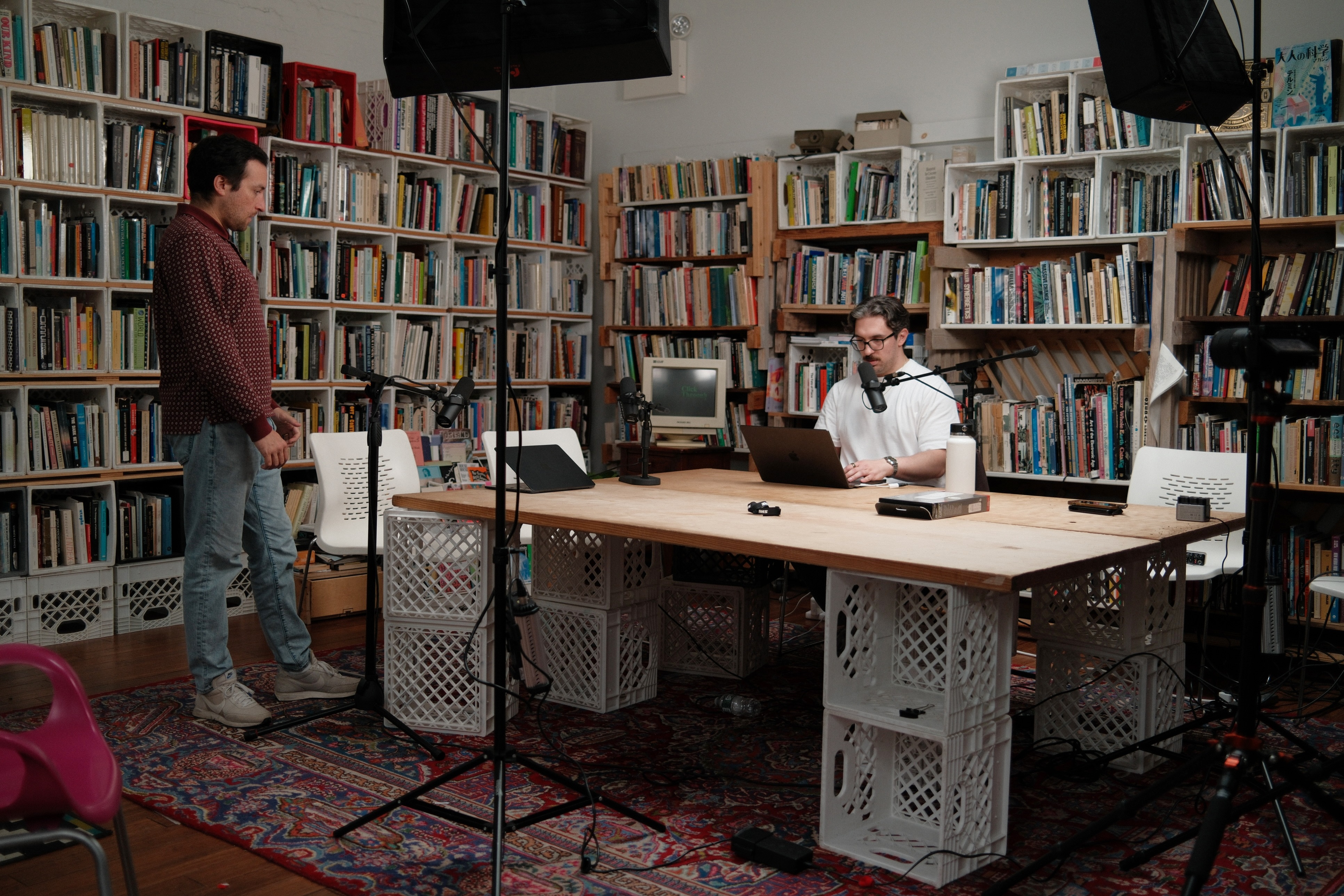
Alongside my best friend Alex, I’m launching a video podcast. It’s called Click Through. We announced it last week, and the first episode comes out tomorrow. It’s a Wikipedia deep dive comedy podcast. Every episode starts with us receiving two semi-random pages and trying to get from one to the other in 60 minutes, only clicking hyperlinks. You can follow along visually with us and our screens. The show is on podcast apps, where you can choose if you consume it via audio or video. But it’s also on YouTube. There’s our Wikipedia tabs as we go on our journey, but there are also visual gags, props, and a rotating group of New York City businesses that opened their doors and let us shoot inside (sometimes for free). Video is baked into the idea. The irony, again, is not lost on me that video made me question if I wanted to stay in podcasting, and has now become a massive part of my future in it. I wrestled with this for a lot of reasons. One immeasurable one: what does seeing us change about our audience’s relationship to us? For the industry, what biases does this create and who does it exclude? That’s a fucking rabbit hole. One measurable one: we’ve spent more money making 12 episodes of this podcast than we’ve spent in 10 years making Tipping Pitches.
Maybe some of you reading this, as creators, are wrestling with these things too. Maybe you don’t care. Maybe it’s pretentious to have this conversation out loud. Maybe it’s necessary. Maybe you’ll hate our new show. Maybe you’ll love it. I don’t know. I know that I love it. It’s a love letter to something I care a lot about (an open internet) that doesn’t take itself too seriously. It’s funny and fun to do. It’s collaborative — aside from me and Alex, six people have dedicated their labor to it, and another dozen have lent ideas, advice, and encouragement (many hands make light work, as they say). It was creatively challenging to make. We’ve finally found what the pivot to video looks like for us. And it’s born from — financially and creatively — the community that we’ve fostered through our niche, audio-only, socialist baseball podcast.

I still believe in podcasting. I believe in its weirdness. I believe in its power to command peoples’ attention for long periods of time and the creative freedom that opens up. I believe listeners want the depth of connection it provides to hosts. I believe many hosts want to make something worth connecting to. I believe there is art in the high and low of podcasting — a form as worthy of the silliest unkillable bits as it is of originally scored music, impassioned voice acting, clever editing, and intellectually curious conversations. I believe in high fidelity audio, yet some of my favorite shows sound like shit. I believe the podcast industry is kind of cooked. I also believe it’s thriving.
The meteor grazed us, but I just checked and it looks like Pro Tools is still running.